Solo Games
Solo Games exist on a spectrum. Shawn Tomkin wrote a Bluesky thread back in January 2025 that tries to categorise some of these solo experiences and I'll be using something like those categories for the various games as they appear on this page. Note - this is a very subjective grouping; plenty of games straddle the line between categories and I reserve the right to add, remove, redefine and generally change my mind at any time.
- Story games - In many ways more of a prompted creative writing exercise than a game. No mechanics, but generally features a gameplay loop that drives the story forward.
- Journaling Games - prompt driven, light mechanics, intended to be a reflective and immersive experience. Usually leave a lot of the heavy lifting to the players's imagination but could in theory be played without journalling, even if the experience would be rather empty.
- Solo-centric RPGs - robust games with mechanical depth, designed to be played without a GM. Often feature oracle and prompt tables to add some of the randomised story-driven elements that would usually come from a GM figure.
- Solo-friendly RPGs - traditional RPGs with an expanded ruleset that facilitates solo play.
- Solo drawing games - games that are based around drawing or sketching rather than written or spoken format story telling.
- Dungeon delvers - robust engines for generating a dungeon, narrower in scope than the solo-centric RPG but more mechanical than a journaling game.
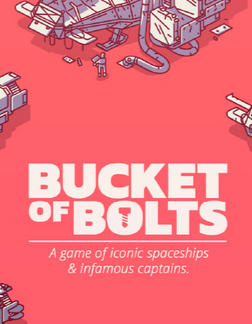
Bucket of Bolts
- Mousehole Press
Bucket of Bolts was my first Story game experience. I bounced off it the first time round because I didn't really understand what I was getting into. I was prepared for a Journalling game, and I ended up with lots of 'journalling' but not a lot of 'game'. It took a year or so of getting used to solo role play and prompt-based mechanics before I came back to it and was able to really let go of those hangups and accept the game for what it is, instead of asking why it wasn't what I expected.
The whole 'Lost & Found' series of games is based on the idea of creating an 'artefact' that can be carried forward into other role playing games. The first game in the series is actually called Artefact and is cited as an inspiration by a host of other solo game designers. In the case of Bucket of Bolts you play as a space ship and you chart its history across different captains and the stories that define the different eras of its working life.
You genuinely only need a copy of the game and a pen and paper to play and the experience is thoughtful - sometimes quite melancholy - rather than action-oriented. The game comes with a 'soundtrack' which is prompted at the end of each round and the 'wait' between captains is a mechanical part of the gameplay experience. Default play time is a couple of hours, but you can alter that by adjusting the number of rounds per era. A good game to keep your mind occupied on a long journey, or a quiet evening.
Resources
Related posts
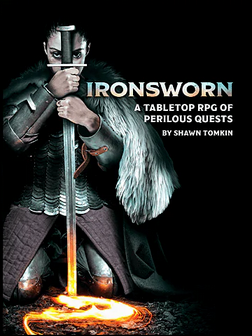
Ironsworn
- Tomkin Press
Ironsworn is the solo game that started me on this journey. It's free to download and very high production quality. There are some paid supplements and physical versions of the various game books and assets that you can buy if you want, but you absolutely don't need them to start playing. If you're looking for a true solo game that is close to the normal TTRPG adventure experience this is the one I'd recommend. The Ironsworn family of games also includes Starforged (Ironsworn in space) and Sundered Isles (Steampunk Pirate Ironsworn).
One of my favourite features of Ironsworn is the world-building exercise that is built into the setup of the game. You are given a template world, an empty Ironlands, and you answer a series of questions to determine your 'world truths'. There are multiple-choice answers that will help you get started as a newbie, but plenty of opportunity to enhance or just completely invent your own answers to those questions once you have a little more experience.
Play itself is based on Moves and your dice rolls determine how the world around you reacts to your actions. Your character is driven by Iron Vows, which are the main narrative mechanic, and the completion of which are the source of experience points. There are no 'classes', your character's abilities are shaped by the Assets you assign them, and those assets can be upgraded over time to enhance their effects. The fiction establishes what moves are possible, the dice roll determines whether you succeed or fail, and then the fiction takes over again as you narrate how the dice result manifests in the game world.
GM-less Co-op is also encouraged and supported by the rules and many consider this the most enjoyable way to play the game. Guided (GM-led) play is supported but the general wisdom is that you need the right kind of player for this heavily narrative game and parties of more than 3 can be a struggle. I've had hours and hours of fun with this game and its siblings and would recommend to anyone who wants to try out the solo TTRPG hobby.
Resources
- The official Ironsworn website
- Me, Myself and Die - Season 2: a Youtube Ironsworn Actual Play by Trevor Devall
- The Bad Spot: A Youtube actual play channel/podcast that heavily features Ironsworn content